Three Manifolds, One Signal — Issue #2
The Rotation Beneath the Surface. Same panel-wide stress signature week 2 — but the macro epicenter has rotated from FX to rates, the STOXX 600 epicenter has rotated from defensive sectors to cyclicals, and Banks & Insurance have been promoted from INDUCED to CORE. We observe a regime reorganizing internally while aggregate dispersion stays compressed.
THREE MANIFOLDS — Weekly Market Reading
Issue #2 · Sunday 10 May 2026
Macro · United States · DACH
Reading as of Friday 8 May 2026 (close) · ~2000 words · 9 min read
By Evangelos Papadopoulos · econosysmographe.com
The reading in one sentence
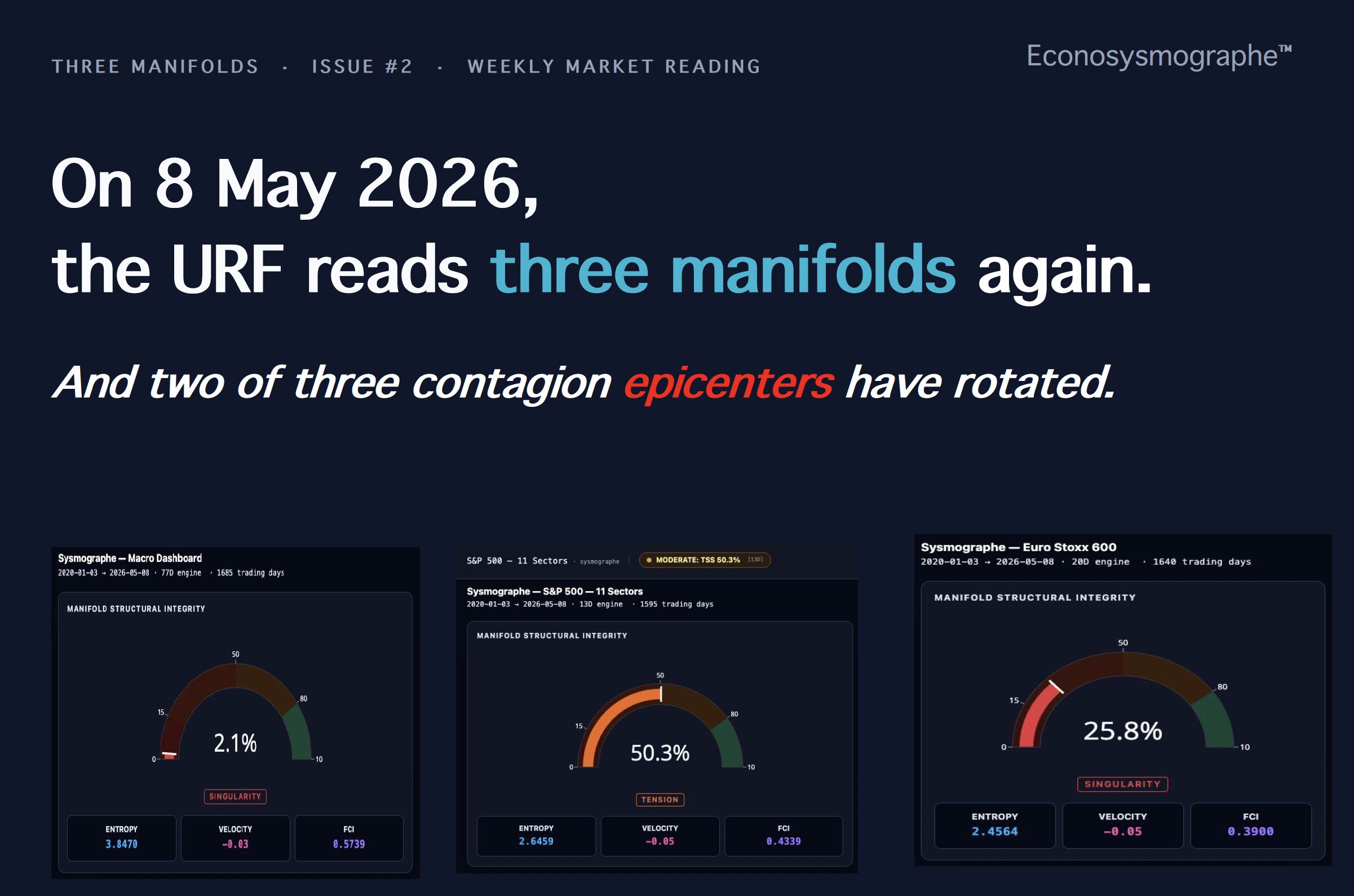
On 8 May 2026, the URF reads three manifolds: the macro layer in deep Singularity (TSS 2.1%, down from 2.3%), the S&P 500 panel in Tension (TSS 50.3%, down from 51.4%), and the STOXX 600 panel in Singularity (TSS 25.8%, down from 28.6%). Each layer is fractionally lower in TSS and higher in FCI than Issue #1 — the manifold’s geometric distance from baseline is accelerating while dispersion compression intensifies. But the headline of Issue #2 is not the aggregate persistence; it is the internal rotation: two of the three contagion epicenters have moved.
This issue documents what changed beneath the surface, why the rotation matters more than the persistence, and what it implies for institutional allocators in the US and the DACH region (Germany, Austria, Switzerland) over the Q2-Q3 2026 horizon. The DACH section flags a structural promotion in the European Banks and Insurance complex that warrants specific attention.
Two prices, three regimes — the framework in two paragraphs
URF works on the geometry of the covariance manifold \mathrm{SPD}(n) — the space of positive-definite matrices that captures how assets co-move. Every traded asset has, at any point in time, two prices: the spot price (what the market quotes today) and the geodesic price (what the covariance manifold structurally implies, derived from the rolling covariance trajectory and the geometric attractor of the system).
The signed gap between them, normalised by a volatility scale, is the deviation σ. The sign defines the regime: Rupture (σ > 0, spot above geodesic, structurally over-priced, mean-reversion expected); Compression (σ < 0, structurally under-priced, recovery is the attractor); Suture (σ ≈ 0, equilibrium with the manifold structure). At the panel level, an aggregate Topological Stress Score (TSS) measures the manifold’s structural integrity — high TSS means dispersion is collapsing toward a single dominant mode; very low TSS means the dispersion has already collapsed (the Singularity zone, where any perturbation propagates globally with no diversifying counterforce).
Reveal #1 — The macro manifold
The macro Sysmographe reads the broadest universe in the URF stack: 77 nodes across seven structural families — US sector proxies (11), country and regional ETFs (15), spot currencies (12), short rates 3M proxies (10), commodities and stress instruments (9), CPI and inflation series (9), and US rates and macro indicators (11). It is the layer where systemic conditions first become visible, before they propagate to equity panels.
On 8 May 2026 the macro reading is:
- TSS 2.1% — Singularity zone. Down from 2.3% on 1 May. The macro manifold has deepened further into Singularity for the second consecutive week. The reading remains the lowest score on record outside the COVID shock window.
- FCI 0.5739 — Moderate. Up from 0.5328 on 1 May (+7.7%). The geometric distance from baseline is accelerating week over week even as TSS deepens. This co-movement of FCI rising and TSS falling is the manifold’s signature for intensifying structural stress, not normalising stress.
- FCI peak 0.9449 on 3 July 2020 (post-COVID rebound calibration); current FCI is at 61% of that peak.
- Entropy 3.8470, mean 4.2005. The drop in entropy continues from last week’s 3.9053 — the manifold continues to lose dispersion.
- Manifold velocity -0.03. Sign-flipped from +0.04 last week. The trajectory has reversed from gradual normalisation toward gradual escalation.
The contagion network on the same date identifies US 5Y Yield as the visible epicenter (CORE, EMISSION) — a complete rotation from Issue #1’s USD/CAD epicenter. The CORE ring contains seven visible nodes: US 5Y Yield, US 2Y Yield, USD/MXN, USD/JPY, USD/CAD, JP CPI, and DBA — the entire short end of the US Treasury curve sits in CORE alongside three USD pairs and Japan CPI. The induced ring contains EUR/USD, Fed Funds Rate, USD/AUD, USD/BRL — a second-order ring of broader rates and FX. The periphery contains US Unemployment, Info Tech, M2 Money Supply, CA CPI, Eurozone CPI, BR CPI, Breakeven Rate 10Y, Gold, and Copper.
The combined reading is structurally different from last week. The dominant variance source has rotated from a USD/CAD-anchored FX cluster (Issue #1 CORE: USD/CAD epicenter, USD/INR, USD/GBP, BR CPI, JP CPI) toward a US-rates-and-USD-strength configuration (Issue #2 CORE: US 5Y Yield epicenter, US 2Y Yield, USD/MXN, USD/JPY, USD/CAD, JP CPI, DBA). The entire short end of the US Treasury curve (2Y and 5Y yields) has entered CORE; three USD pairs (against MXN, JPY, CAD) form a USD-strength sub-cluster; JP CPI links the JPY axis to inflation transmission. Notably, Breakeven Rate 10Y has rotated outward to PERIPHERY — long-end inflation expectations read calm even as short-end rates stress dominates the manifold’s variance.
For a US risk officer, the rotation says the entire short end of the Treasury curve has moved to the centre of the manifold’s variance structure. The transmission path is now rates-led, not FX-led, and short-end-led rather than long-end-led. For a DACH allocator, the rotation matters in two ways: first, EUR/USD has rotated from CORE in Issue #1 to INDUCED in Issue #2, meaning direct EUR transmission is now second-order; the cross-Atlantic transmission path runs through broader USD-strength dynamics rather than direct EUR stress. Second, Switzerland — flagged as a critical induced node in Issue #1 — is no longer visible in the standard 20-node network labelling this week, suggesting either rotation to PERIPHERY or movement into a region of the 77-node network not labelled by default.
In practice this week — what to look for on your own dashboards:
The conventional metrics (CDS spreads, VaR, realised volatility) read the same calm conditions as last week. The structural fragility has not closed; it has reorganised. The source of upstream pressure has shifted from an FX cluster (USD/CAD, USD/INR, BR/JP CPI) to a US-rates-and-USD-strength cluster (US 5Y Yield, US 2Y Yield, USD/MXN, USD/JPY, USD/CAD, JP CPI, DBA). For a US risk officer, the entire short end of the Treasury curve sitting in CORE is the specific signature: 2Y and 5Y rate stress are at the centre of the manifold’s variance, while long-end inflation expectations (Breakeven 10Y) have rotated to PERIPHERY. The yield curve is structurally compressed at the front end. For a DACH allocator, EUR/USD now in INDUCED (not CORE) means direct euro-area FX transmission is second-order; the cross-Atlantic linkage operates through broader USD-strength rather than EUR-specific stress.
Reveal #2 — The S&P 500 sector panel
The US Sysmographe reads the eleven S&P 500 sector ETFs as a connected panel. The Cone Matrix view extends to 13 components by adding the commodity proxies GLD and USO for the SPD(13) manifold decomposition. On 8 May 2026:
- TSS 50.3% — Tension zone. Down from 51.4% last week (-1.1pp), still above the 50% threshold marking broad sector dispersion stress.
- FCI 0.4339 — Stable in zone classification, but up from 0.3854 last week (+12.6%). As on the macro layer, FCI is rising while TSS is fractionally normalising — the same divergence signal.
- 11 of 11 sectors in Rupture regime — second consecutive week. Zero in Compression, zero in Suture.
- Mean residual σ̄ = +24.6% above the geodesic, essentially unchanged from last week’s +24.5%.
- Widest gap: Communication Services (XLC) at +40.1% — second consecutive week as the widest. Spot trades 49.3% above its geodesic price; closing the gap, all else equal, would require a -33.0% correction on XLC.
The full sector breakdown, sorted by deviation:
| Sector | ETF | Deviation σ above geodesic |
|---|---|---|
| Communication Services | XLC | +40.1% |
| Real Estate | XLRE | +30.3% |
| Consumer Discretionary | XLY | +29.5% |
| Energy | XLE | +28.4% |
| Materials | XLB | +25.0% |
| Utilities | XLU | +24.3% |
| Industrials | XLI | +22.5% |
| Financials | XLF | +20.6% |
| Health Care | XLV | +18.1% |
| Consumer Staples | XLP | +16.3% |
| Information Technology | XLK | +16.1% |
The contagion network on the S&P 500 places XLE (Energy) as the principal-component epicenter (PC10) — unchanged from Issue #1.
The SPD(13) Cone Matrix view — where structural survival concentrates
The Cone Matrix view of the S&P 500 panel reads ISOTROPIC ZONE at TSS 50.3%, with DP global 4.5572, Ricci mean -48.45, and Ricci min -117.56 (deeply negative curvature, consistent with a manifold in advanced contraction). The full classification across the 13 SPD components places six in LOW-TSS (zero structural survival capacity) and seven in HIGH-TSS (residual structural capacity). Critically, the sector TSS heatmap shows where the surviving capacity concentrates:
| Sector | TSS sector |
|---|---|
| Industrials | 47.5% |
| Health Care | 20.1% |
| Commodities (GLD/USO) | 9.5% |
| Consumer Staples · Energy · Materials · Comm Services · Cons Discretionary | 0.0% |
Eight of the eleven equity sectors read 0.0% TSS sector — they contribute nothing to the manifold’s structural integrity. The diversification reservoir is concentrated in three regions: Industrials (XLI, the highest survival score), Health Care (XLV), and the commodity proxies (GLD and USO). The PC1 component itself maps to XLI Industrials, with the lowest DP (3.62) and HIGH-TSS classification — the manifold’s first-order survival anchor is Industrials.
The historical baseline matters and the trigger condition is now sustained for two consecutive weeks. The “9 of 11 S&P 500 sectors in Rupture, sustained at least one calendar month” configuration appeared three times in the modern sample (1999–2026): Q4 1999 (twelve months before NASDAQ peak), Q2 2007 (fifteen months before Lehman), and Q3 2019 (six months before the COVID shock). Subsequent S&P 500 drawdowns were -49%, -55%, and -34%, average -46%. Issue #1 documented the configuration as fresh; Issue #2 documents it as persistent.
In practice this week — what to look for on your own dashboards:
The persistence is the story. The widest gap (XLC at +40.1%) and the contagion epicenter (XLE) remain dissociated, which is the URF signature of a structurally exhausted bull regime. The Cone Matrix sector TSS heatmap surfaces a finding the sector ETF dashboard cannot: only three regions of the SPD(13) manifold carry residual structural integrity — Industrials, Health Care, and the commodity proxies. Eight of eleven equity sectors are operating at zero diversification contribution. A US risk officer’s existing factor exposure dashboard would not flag this; the structural reading does. The historical analog window (Q4 1999, Q2 2007, Q3 2019) sits between 6 and 15 months before the realised drawdown — that window has now been open for two consecutive weeks on the current panel.
Reveal #3 — The STOXX 600 sector panel · DACH anchor
The European Sysmographe reads the twenty STOXX 600 sectors as a connected panel. The STOXX 600 is the canonical European equity benchmark used by DACH institutional allocators — DWS, Allianz GI, Union Investment, Deka, Erste AM, UBS AM, Pictet, Lombard Odier, Vontobel, Julius Baer — for their broad European exposure. Germany alone weighs approximately 15% of the STOXX 600 by free-float capitalisation, and the entire DAX top-10 sits inside the panel-wide Rupture footprint identified by the panel-wide reading.
On 8 May 2026:
- TSS 25.8% — Singularity zone. Down from 28.6% on 1 May (-2.8pp). The European panel has deepened the most of the three layers this week.
- FCI 0.3900 — Stable, with FCI peak 0.7944 on 9 March 2022 (pre-rate-hike cycle calibration).
- Entropy 2.4564, mean 2.5086. Down from 2.5719 last week — continued dispersion loss.
- Manifold velocity -0.05. Sign-flipped from +0.02 last week, accelerating into deeper Singularity.
The contagion network identifies a CORE cluster of six sectors — Chemicals (epicenter), Travel & Leisure, Automobiles, Insurance, Health Care, and Banks — a complete rotation from Issue #1’s defensive CORE (Retail, Basic Resources, Broadcasting, Food & Beverage, Utilities). The induced ring now contains Media, Oil & Gas, Utilities, Retail, Personal & Household Goods, and Broadcasting — last week’s CORE composition has been displaced one ring outward. The principal-component epicenter is Chemicals.
The Two-Prices regime distribution on the STOXX 600 carries an additional finding this week. Of the 20 sectors:
- 19 in Rupture regime (95% of the panel), mean residual σ̄ = +27.1% above the geodesic
- 1 in Suture regime — Travel & Leisure at +11.8%, the only sector in geometric equilibrium with its manifold
This is the first time across either equity panel (S&P 500 or STOXX 600) that any sector has registered a non-Rupture classification since the test phase began with Issue #1. Travel & Leisure is also visible in the CORE ring of the contagion network — placing it simultaneously at the centre of the structural variance and at a residual diversification anchor on the Two-Prices view.
The widest gap on the European panel is Insurance at +37.23% — spot trades 45.1% above its geodesic price; closing the gap would require a -31.1% correction on the Insurance super-sector. The full sector breakdown, sorted by deviation:
| Sector | Deviation σ | Regime |
|---|---|---|
| Insurance | +37.2% | Rupture |
| Personal & Household Goods | +35.9% | Rupture |
| Construction | +32.9% | Rupture |
| Automobiles | +30.3% | Rupture |
| Food & Beverage | +30.1% | Rupture |
| Real Estate | +30.0% | Rupture |
| Financial Services | +29.3% | Rupture |
| Banks | +28.2% | Rupture |
| Media | +28.0% | Rupture |
| Oil & Gas | +27.2% | Rupture |
| Basic Resources | +26.3% | Rupture |
| Retail | +24.6% | Rupture |
| Telecom | +24.0% | Rupture |
| Industrials | +23.5% | Rupture |
| Chemicals | +22.9% | Rupture |
| Health Care | +22.8% | Rupture |
| Broad Market | +22.8% | Rupture |
| Technology | +20.8% | Rupture |
| Utilities | +17.8% | Rupture |
| Travel & Leisure | +11.8% | Suture |
The same dissociation observed on the S&P 500 is now present on the STOXX 600: the widest residual sector (Insurance) and the contagion epicenter (Chemicals) are not the same. This is the URF signature of an advanced panel-wide Rupture in mirror configuration on both sides of the Atlantic.
The Banks + Insurance promotion to CORE — the cleanest signal of Issue #2
The most consequential delta this week is in DACH-relevant sectors. Issue #1 placed Banks and Insurance in the INDUCED ring of the contagion network — second-order exposure to the panel-wide stress. Issue #2 places both in CORE — first-order exposure. For DACH portfolios with significant Allianz, Munich Re, and Deutsche Bank weight, the structural classification has materially shifted upward in priority.
Cross-referencing with the DAX 40 deep-dive from Issue #1: Allianz and Munich Re sit in Insurance (DP 15.92), Deutsche Bank sits in Banks (DP 16.82). Last week these names were INDUCED. This week they are in the CORE ring of the panel, alongside the contagion epicenter (Chemicals) and the widest residual sector (Insurance, which is also now in CORE).
The diversification paradox flagged in Issue #1 takes a different form this week. A Frankfurt allocator with DAX-heavy exposure had structural tilt away from the Issue #1 CORE composition (Retail, Food & Beverage, Utilities, Basic Resources, Broadcasting). With Issue #2’s CORE rotation toward Banks, Insurance, Chemicals, Travel & Leisure, Automobiles, and Health Care, the DAX 40 top-10 now has three names directly in the CORE ring: Allianz, Munich Re, and Deutsche Bank. The protection that the Industrials concentration of the DAX provided last week (4 PERIPHERY names: Siemens, Siemens Energy, Airbus, Rheinmetall) has been partially offset by the financial-complex promotion to CORE.
In practice this week — what to look for on your own dashboards:
A Frankfurt allocator now has three top-10 names — Allianz, Munich Re, Deutsche Bank — inside the first-order CORE ring of the European contagion structure. Last week they were second-order INDUCED. The structural classification has been promoted by one full ring. Insurance is simultaneously the widest residual on the STOXX 600 (+37.2%, fermeture -31.1%) AND in the CORE — both signals concur in flagging the European Insurance complex as a first-order tension point. The static mapping is what the manifold reads on 8 May 2026, and may rotate again in Issue #3. Travel & Leisure as a single Suture sector at +11.8% is the manifold’s residual diversification anchor across both equity panels. We make no directional inference from any of these mappings — they are static snapshots of constituent classification against the dashboard’s current contagion structure.
Why the three layers together matter
The configuration on 8 May 2026 is persistent at the aggregate level and reorganising internally. Both observations carry narrative weight:
The macro layer has rotated its dominant variance source from a USD/CAD-anchored FX cluster (Issue #1 CORE) to a US Treasury short-end + USD-strength + JP CPI cluster (Issue #2 CORE). Both readings sit in deep Singularity, but the upstream signal is now rates-driven and short-end-driven, not FX-driven. The yield-curve front end (US 2Y + 5Y yields) is structurally compressed at the manifold centre, while long-end inflation expectations (Breakeven 10Y) have rotated to PERIPHERY. Switzerland — flagged in Issue #1 as the critical DACH-side induced node — is no longer in the visible 20-node labelled subset of the 77-node manifold.
The S&P 500 panel persists. Same epicenter (XLE), same widest gap (XLC), same 11 of 11 Rupture, σ̄ unchanged at +24.6%. But the SPD(13) Cone Matrix view reveals that only three regions of the manifold (Industrials, Health Care, commodities) carry structural survival capacity — eight of eleven equity sectors at zero contribution to the manifold’s structural integrity. The historical analog window (Q4 1999, Q2 2007, Q3 2019) is now extended into a second consecutive week.
The STOXX 600 panel has rotated its CORE composition entirely. Defensive sectors (Retail, Food & Beverage, Utilities) demoted to INDUCED. Cyclical and financial sectors (Chemicals, Insurance, Banks, Health Care, Automobiles) promoted to CORE. Travel & Leisure became the only Suture sector across both equity panels we read — the first non-Rupture classification of the test phase.
The bonus sub-manifold reads support the dissociation theme. Gold spot ($4,731) trades 14.4% below its geodesic price ($5,402) — a SUTURE regime, the second non-stressed read alongside Travel & Leisure. Brent crude trades at $101.29 against a geometric equilibrium of $109.16 — a 7.8% Ricci Gap, classified UNDERVALUED. The dissociation runs across the commodity complex: DBA (agriculture proxy) sits in macro CORE as a first-order variance source, while Gold and Copper are visible in macro PERIPHERY — the manifold reads them as calm. Physical hard commodities are pricing below their structural equilibrium and classified at the outer ring of the contagion structure; the agricultural transmission is at the manifold centre. This is the dissociation a path-dependent stress would resolve.
A quantitative news cross-check supports the structural reading. The Trident-AI sentiment engine (VADER NLP applied to the NewsAPI feed) reads, for the same 8–9 May 2026 window: S&P 500 news sentiment NEUTRAL at -0.18 with bearish consensus, with the dashboard surfacing an explicit DIVERGENCE flag — “TSS signals calm but news is bearish — market geometry diverges from narrative”. The flag is the news layer’s confirmation of what the URF reads on the structural layer: conventional metrics (and now also conventional commentary) describe calm conditions, while the manifold geometry has been in panel-wide Rupture for two consecutive weeks. Gold news sentiment BULLISH at +0.47, aligned with the Gold submanifold’s SUTURE / undervalued classification. Oil news sentiment NEUTRAL at +0.03, aligned with Brent’s UNDERVALUED Ricci Gap. On gold and oil, narrative and structure read the same direction. On the S&P 500, narrative and structure now read a documented divergence.
In practice this week — what to look for on your own dashboards:
The persistence at aggregate level masks a rotation in source narrative. The macro variance driver moved from currency to rates. The European contagion epicenter moved from defensive to cyclical/financial. Banks and Insurance — the DACH-specific complex — were promoted from second-order to first-order exposure. The framework’s reading is internally consistent: stress persists, internal reorganisation is the new layer of the signal.
Tactical implications for Q2-Q3 2026
We do not produce target prices, recommended trades, or directional positions. URF produces structural readings of the covariance manifold and identifies the regime each asset is in. From the 8 May 2026 reading, three positioning observations follow naturally for institutional allocators.
For US allocators. The 11 of 11 Rupture configuration is now persistent for two consecutive weeks; the historical analog window (Q4 1999, Q2 2007, Q3 2019) is sustained. The widest single-sector deviation (XLC at +40.1%) and the contagion conduit (XLE) are unchanged from Issue #1 — when realignment triggers, the URF signature suggests propagation from the Energy conduit toward the Communication Services tension point. The Cone Matrix sector TSS heatmap identifies Industrials (47.5%), Health Care (20.1%), and the commodity proxies (GLD/USO at 9.5%) as the only structural survivors among the SPD(13) components. A manifold-aware allocator can read this as: gross exposure scaled inverse to σ may be over-concentrated if it ignores the diversification reservoir’s collapse to three regions of the manifold.
For DACH allocators. The Banks + Insurance promotion to CORE is the cleanest delta of the issue. Allianz, Munich Re, and Deutsche Bank — three of the DAX 40 top-10 — now sit in the first-order ring of the European contagion structure, where last week they were second-order. Insurance is simultaneously the widest STOXX residual (+37.2%, -31.1% to close the gap) and in CORE — both signals concur. A DACH allocator with significant DAX-tracking exposure should re-examine the diversification paradox flagged in Issue #1: the Industrials-dominant tilt of the DAX top-10 still provides partial protection against panel-wide Rupture, but no longer shields against the specific Banks/Insurance escalation that Issue #2 documents. Switzerland’s exit from the visible induced ring this week should not be over-interpreted; it may have rotated into the unlabelled subset of the 77-node manifold rather than out of the stress structure entirely.
For both. Travel & Leisure as a single Suture sector at +11.8% deserves attention. Together with Gold at σ -14.4% (SUTURE) and Brent at +7.8% Ricci Gap (UNDERVALUED), three points across the broader manifold structure are pricing at or below their geodesic equilibrium while the equity panels remain saturated with Rupture. The dissociation is a structural reading, not a directional view. We make no inference about resolution path. We observe that in panels otherwise saturated with stress, the residual diversification capacity has narrowed to a small number of named anchors. This is a horizon signal, not a timing signal. The framework continues to read regime, not date.
Why URF sees this when conventional dashboards do not
Most institutional risk dashboards monitor spot prices, returns, realised volatility, factor exposures, and VaR. None of those metrics flags an over-priced manifold — each measures a projection of the underlying geometry, and projections can look entirely normal even when the structure beneath them is exhausted. URF measures the geometry itself. The Rupture regime, panel-wide, is the measurable signature of what Hyman Minsky described in plain language fifty years ago: stability breeds instability. The Econosysmographe™ makes that configuration computable, daily, on standard infrastructure, with the same operations every reading and no per-input attribution drift.
What conventional dashboards also miss is internal rotation under stable aggregate stress. The S&P 500 reading on 8 May 2026 looks identical to 1 May 2026 in headline metrics: same TSS zone, same epicenter, same widest gap, same panel-wide Rupture. The framework reads the rotation in the SPD(13) Cone Matrix and the contagion network ring composition. A US risk officer monitoring Tension Zone TSS week over week would see persistence; the URF reads persistence plus internal reorganisation. The internal reorganisation is where the next layer of risk-officer signal lives.
What this is not
This article is not a market call. The framework does not produce target prices, recommended trades, or directional positions. It produces a structural reading of the covariance manifold and identifies the regime each asset is in. The reading on 8 May 2026 says what it says; the historical precedent has consequences; what those consequences look like is not in the framework. What is in the framework is the daily reading itself — produced as a 15-minute batch on standard infrastructure, fully auditable, IFRS 9 and SEC Rule 18f-4 compatible, with the same operations every day and no per-crisis tuning.
Three Manifolds — every Sunday
This is Issue #2 of Three Manifolds — Weekly Market Reading. Every Sunday until early November 2026 we publish the same three-layer structural reading, in the same order: Macro, United States, DACH. The framework is identical week over week — only the data and the questions change. The intent is to give US and DACH institutional allocators a recurring, reproducible structural signal that complements (and does not replace) their existing risk processes.
- For institutional inquiries (POC, deep-dive, allocation discussion) → econosysmographe.com/contact
- Direct contact → contact@econosysmographe.eu
- Methodology → econosysmographe.com/methodology
About Econosysmographe™
Deep-tech financial geometry. Independent research published on SSRN — URF-1: The Universe Risk Framework, URF-2: Crisis Detection on the SPD Manifold, URF-3: Two-Price Equilibrium and Geodesic Convergence, with URF-4: Lorentzian Signature of the Manifold in preparation. Core theorems formally verified in Lean 4 + Mathlib — Theorems 11.1 to 11.3 on Two-Price equilibrium existence and uniqueness, Theorem 12.1 on Lyapunov suture stability of the geometric attractor.
26-year forensic backtest across the 1999 dot-com, 2007 global financial crisis, 2019 repo stress, 2020 COVID shock, and 2023 regional banking turbulence. 77-node macro manifold, 11 S&P 500 sectors (SPD(13) extended Cone view), 20 STOXX 600 sectors, delivered as a 15-minute daily batch on standard infrastructure. Built around the proprietary Papadopoulos Distance on \mathrm{SPD}(n) — the metric the dashboard reports as DP.
Q2 2026 institutional POC slots are open — for US risk officers and DACH asset managers who want to see their own portfolio’s manifold reading. Early-stage investor conversations welcomed — Econosysmographe™ is in seed-stage formation and engaging with deep-tech and family-office capital partners.
- contact@econosysmographe.eu
- econosysmographe.com
- econosysmographe.com/institutional-access/ — institutional contact form
- LinkedIn: Evangelos Papadopoulos
Educational purpose only. Not financial advice. SmartGreenInvest Ltd (Reg. England & Wales No. 14636473) is not an FCA-authorised firm.
Evangelos Papadopoulos · Independent Researcher · econosysmographe.com · contact@econosysmographe.eu
Trademark notice and source attribution
DAX® is a registered trademark of Deutsche Börse AG. STOXX® and STOXX Europe 600® are registered trademarks of STOXX Ltd, a Qontigo company. SPDR® and the S&P 500® names are registered trademarks of State Street Corporation and S&P Dow Jones Indices LLC respectively. Use of these names in this article is for editorial reference and analytical commentary only. SmartGreenInvest Ltd is not affiliated with, sponsored by, or endorsed by any of these index providers.