The End of the Black Box: Why We Are Moving from Machine Learning to Financial Geometry
For a decade, the financial industry has been obsessed with Machine Learning (ML). We were no exception. We spent years building supervised models for company ratings, loan origination, and credit scoring—achieving the industry standard of 95% to 99% accuracy.
But when we challenged our models to anticipate structural market crises—the true test of any risk framework—the results were sobering: Zero success.
This failure forced us to ask a fundamental question: What is a financial market, mathematically?
The answer led us to move beyond pattern recognition toward the causal architecture of markets.
1. The Limitation of the ML Paradigm
ML is an interpolator. It excels at finding correlations in stable environments, making it perfect for static scoring tasks like credit approval. However, financial markets are not static; they are dissipative systems that undergo structural phase transitions.
When a crisis hits, historical correlations break down. ML, blinded by its reliance on past distributions, fails because it lacks a causal framework. Furthermore, the operational cost (TCO) of maintaining these models has become a burden. Between the demands of Model Risk Management (MRM), regulatory compliance, and Explainable AI (XAI) audits, the operational cost of ML in production has skyrocketed—increasing by 2x to 5x depending on organizational maturity.
2. The Geometric Shift: Information, Causality, and Space
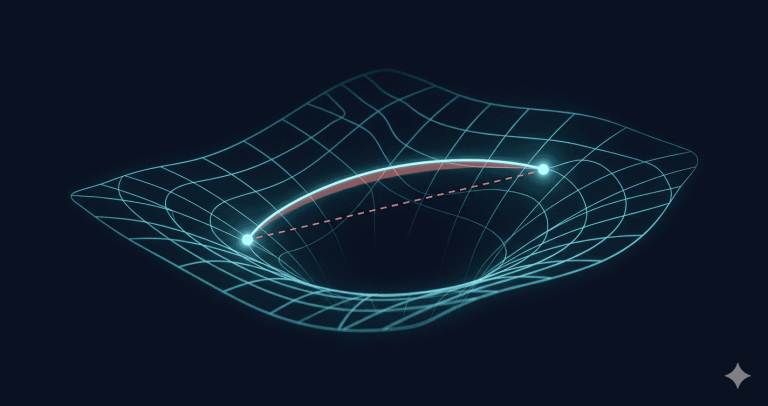
Our research at Trident-AI has shifted toward Financial Geometry. We no longer view the market as a collection of independent observations, but as a system of interdependent flows—equity momentum, sovereign rates, and credit conditions—all coupled and evolving on a manifold.
- Information Geometry (The Anatomy of Contagion): ML sees correlation; we see contagion. We track how stress propagates and deforms the market manifold, signalling a pre-rupture phase months before prices react.
- Lorentzian Geometry (The Physics of Causality): Classical finance treats the future as a random walk. We treat the future as a path causally constrained by the current geometric state. Prices are attracted to a geometric equilibrium \(P_{geo}\). When spot prices diverge from this trajectory, structural tension accumulates.
3. Beyond the Horizon: Lévy, Besov, and Geometric Accumulation
We are currently pushing the boundaries of this research by integrating Lévy processes within Besov spaces.
- Lévy Processes allow us to model the discontinuous “jumps” that Gaussian-based models ignore.
- Besov Spaces provide the framework to analyze the “smoothness” or “roughness” of these manifolds.
Our hypothesis is that traditional “chartist” patterns are not just visual artifacts—they are geometric regions of accumulation on the manifold, where structural tension is building or resolving.
Conclusion: A New Era
ML remains a powerful “muscle” for execution, but it is not a “brain” for systemic risk.
Our position:
- The Geometry (The System): Defines the causal landscape and structural risk.
- The ML (The Execution): Optimizes strategy within geometric constraints.
The era of the “Black Box” is ending. The era of Causal Financial Geometry has begun.
The Road Ahead
We have established that while ML is an efficient tool for execution, it is not a robust brain for systemic risk. But there is a more profound vulnerability hidden within the “Black Box” architecture that the industry rarely discusses: Adversarial fragility.
Are your ML models vulnerable to adversarial cyber-attacks that could trigger catastrophic decisions? Stay tuned. Follow us on LinkedIn to stay updated on our research. Next Sunday, we will dive deep into how ML systems can be manipulated through cyber-attacks—and why a geometric approach is mathematically immune.
Econosysmographe™ | TRIDENT-AI Research
Read the full paper: “The Geometry of Risk” on SSRN.