Is Your Risk Model Missing What Sterling Is Absorbing?
A UK Special on the cost of running one interest rate on six economies.
Three Manifolds · Special Edition · Sunday 28 June 2026 · 8 min read
Key takeaways · 30-second read
- PERSISTENCE MSCI_UK has held the macro CORE in four of the last five issues (#5, #7, #8, #9) — three consecutive since Issue #7. USD/GBP has been the explicit emission epicenter in two of the last nine (Issue #5 #SterlingChannel + Issue #8). This week the FX epicenter rotated to USD/AUD — *internal* to the dollar-pair cluster, not exit from it. The Sterling complex remains structurally bound to the macro signal.
- ASYMMETRY The Bank of England operates one Bank Rate. It lands on six radically heterogeneous UK sub-systems — mortgages, property, banks, pensions, gilts, sterling itself — with different lags and elasticities. An equity index averages the response into a single number. The manifold reads each sub-system’s dispersion separately.
- LENS What the manifold offers is a measurement *lens* on the sector-asymmetric response to a single-rate policy tool. It is not, and is not proposed as, a policy *prescription*. The distinction matters for what an allocator can do with it.
- FOR AN ALLOCATOR Sterling-exposed books need to see the FX cluster (USD/GBP + EUR/GBP + USD/EUR + USD/AUD this week) as a single load on a single signal, not independent positions. The UK rate-sensitive equity complex (Banks, REITs, Utilities) responds on a different elasticity than the FTSE 100 index average.
Apply for Institutional Access — 20 spots open →
On the σ and zone notation → σ is the Two-Prices dispersion score: how far an asset’s spot price sits from its geometric-equilibrium (geodesic) price on the curved manifold of correlation matrices, expressed as a percentage. Higher = wider structural gap; ~90% is the manifold’s empirical ceiling. The regime label — rupture (stretched above zero, the dominant regime in this market), suture (compressed below) — characterises the geometric state. Contagion zones describe a node’s role in the joint dispersion: CORE absorbs the most contagion-mediated stress; induced carries directional emission; periphery sits at the structure’s edge. Full methodology at econosysmographe.com/methodology.
Four central banks moved. Sterling absorbed structurally.
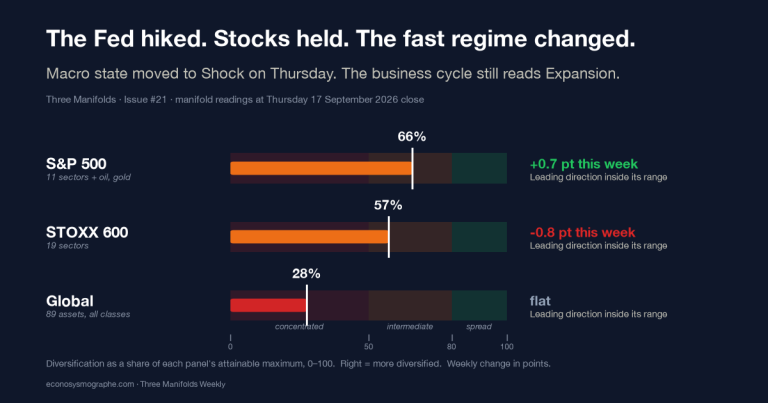
Last week, four central banks moved in near-synchrony. The Federal Reserve stripped its easing bias from the FOMC statement. The Bank of Japan hiked to its highest policy rate since 1995. The European Central Bank delivered its first rate increase since 2023. And the Bank of England held with a hawkish 6-3 vote split, even as UK inflation and labour data softened. DXY closed +1.1% on the week at 100.76, its highest level since May 2025. USD/JPY punched through 161 mid-week — the yen’s weakest print against the dollar in four decades. USD/GBP tested 1.34 as sterling absorbed the transatlantic hawkish spillover. This Friday’s close then added an unusual cross-asset overlay: Gold −3% on the week, Bitcoin below sixty thousand, Brent tracking a weekly loss of more than nine per cent, all while the dollar tightened further to a thirteen-month high. The companion Three Manifolds — Issue #9 records the geometric signature of that Friday move: the macro layer released 0.24 points of joint dispersion while the S&P and STOXX sub-panels absorbed 2.48 between them, and the US 3-month bill crossed σ 90% — the threshold Issue #8 had flagged as the marker of a new amplification regime.
That cross-asset story is the companion reading. This Special traces a different thread that has been running underneath the standard reading for two months. In Issue #5 (31 May), the macro contagion epicenter was USD/GBP — the #SterlingChannel issue, the first time the geometry placed an FX pair at the emission centre of the 77-node macro panel. The epicenter rotated to TLT in Issue #6, to USD/AUD in Issue #7, returned to USD/GBP in Issue #8 (21 June), and this Sunday rotated again to USD/AUD. Two of nine issues have placed Sterling itself at the explicit emission centre.
The single-epicenter count understates the persistence. Across the four issues since the original #SterlingChannel reading, MSCI_UK has held the macro CORE in three of them — out of the structural ring only in Issue #6, returning in #7, #8, #9 with explicit emission direction in the last two. The Sterling complex is structurally bound to the macro signal even when sterling itself yields the FX epicenter to AUD or another dollar-pair name. That is what makes the Sterling Channel load-bearing: persistence at the structural level, not just at the emission level.
The Sterling Channel — what the manifold has been catching since 31 May
The dollar-pair cluster is the FX block on which the Sterling Channel emission has been rotating. The macro contagion network places USD/GBP alongside EUR/USD, USD/JPY, USD/AUD, and USD/CAD as a co-loading complex; the pairs do not move independently and have not done so over the five-issue series. EUR/GBP tracks the same dollar signal. In dispersion terms, the cluster is one trade against one signal, expressed through whichever individual pair carries the explicit emission badge that week — USD/GBP in Issues #5 and #8, USD/AUD this week (Issue #9) and previously (Issue #7), TLT in the same role in Issue #6.
Two distinct geometric quantities are at work here and the distinction is load-bearing for the reading. Emission rotation is the week-on-week question of which individual node carries the explicit epicenter badge — a relocation property of the contagion network’s directional channel. Co-loading persistence is the question of whether the Sterling complex’s charge on the dominant dispersion factor decreases when the badge rotates away from USD/GBP. Across the five-issue series, the second has not decreased: MSCI_UK has held the macro CORE in four of the last five issues — three consecutive since Issue #7 — co-occupying the structural ring with duration-block positions (TLT, US 10Y, US 5Y) and dollar-pair co-loaders throughout, including the weeks when the FX epicenter rotated to USD/AUD or TLT. The reading the manifold gives is on the structural co-loading, not on the badge rotation; the rotation is a property of which name the epicenter prints on, the co-loading is the property of whether the Sterling complex carries it.
The same period saw Bank of England communications maintain a hawkish split despite softening UK inflation and labour data. The MPC has held Bank Rate steady; the vote split has retained the hawkish bias. We do not propose to read BoE intent from a vote split. We do read the Sterling Channel persistence: in the manifold’s terms, the UK monetary stance is being absorbed by the FX cluster rather than dispersed into other sub-systems. That absorption pattern, combined with MSCI_UK holding the macro CORE three consecutive issues since Issue #7, is what makes the Sterling Channel structural at the dispersion level — not just at the emission level.
This week’s macro-velocity reading — dp_velocity 1.21, amplified from Issue #8’s 0.93 — adds a further property to the configuration. The system is escaping its Singularity zone faster than last week. A configuration that the geometry has been catching at a stable structural level for two months is now accelerating its dispersion-relocation behaviour. The Sterling complex is bound to that acceleration through its CORE position.
Apply for Institutional Access (20 spots, institutional only) →
What a single Bank Rate cannot see
A central bank operating a single policy rate is, by construction, deploying a representative-agent tool. The instrument acts on the macro aggregate the central bank’s model assumes into existence. The MPC’s Bank Rate is the canonical example: it presses on the whole UK economy at once, calibrated to deliver the inflation target.
The UK economy does not respond as a representative agent. It responds as six interlinked sub-systems:
- Mortgage holders receive the rate move through new fixings and standard-variable adjustments within months. The pass-through is incomplete — many mortgages are already on fixed rates from earlier vintages — but for new and re-fixing borrowers, the rate transmits within a single quarter.
- Floating-rate business facilities reprice within weeks. SMEs without rate hedges feel the move first; corporates with treasury programmes can defer, smooth, or hedge.
- Pension fund liabilities reprice through the long end of the gilt curve within days. The 2022 LDI sequence — sterling depreciation, gilts repricing, liability-driven margin calls, Bank of England intervention on 28 September 2022 — is the documented case where this transmission channel turned operational. We describe the chain as a known mechanism, not as a claim that the framework would have detected it. The British manifold reading that would test such a claim has not been constructed.
- Cash savers receive the move within the same window. The asymmetric distributional consequence here is well-understood in policy debate.
- UK banks feel the move twice — once on liability cost, once on asset-side credit deterioration in rate-sensitive borrower segments. Net interest margin can widen or narrow depending on the curve shape and the loan-book composition.
- Sterling itself reprices in the FX market within minutes. Sterling is the visible end of the entire transmission chain — and, not coincidentally, the macro epicenter the manifold has been pointing at.
Each sub-system responds with a different lag, a different sensitivity, and a different set of second-order consequences for the institutions that lend to, invest in, or hedge that sub-system. An equity index — even a UK-specific one like the FTSE 100 — averages this response into a single price-return number. The FTSE close on a given Friday is a market-cap-weighted aggregate over constituents whose individual rate sensitivities span a factor of five or more. The aggregate moves; the dispersion across constituents tells a different story.
The manifold reads the dispersion. Across the four-issue series since the Sterling Channel was first flagged, the macro contagion CORE has held Sterling alongside US rates (TLT, US 10Y, US 5Y), Sterling-exposed equity blocks (MSCI UK in particular), and FX co-loaders. That co-loading is the dispersion-level evidence that the single Bank Rate is landing on heterogeneous sub-systems — exactly the structural condition that motivates sector-aware macroprudential tools internationally.
A lens, not a prescription
This Special makes a careful distinction we want to be explicit about. The geometric reading on the Sterling Channel describes the dispersion structure of the response. It does not prescribe what monetary or macroprudential policy should do about that response.
Sector-aware prescription is the proper domain of central banks and their statutory committees. The Bank of England’s twin-committee architecture — the MPC’s Bank Rate alongside the FPC’s sectoral tools (Countercyclical Capital Buffer, sectoral variants, LTV recommendations) — is a sophisticated policy response to precisely the heterogeneity we describe. We do not propose to displace, second-guess, or improve upon that policy architecture.
Sector-aware observation is a different kind of instrument. A geometric reading on the dispersion structure is the observation; the policy choice is downstream. The audience for this Special is allocators, risk officers, and asset managers — readers whose decisions are about positioning a book, hedging an exposure, and sizing a cluster trade. For those readers, the lens is operational: it says where the structural co-movement is concentrated and which sub-systems are absorbing the response with the highest elasticity.
For policy makers, the lens may also be of analytical interest — but they would be the natural users of it, not the audience we are proposing it to. This Special does not address the Bank of England directly. The decision whether to engage with the framework on supervisory grounds belongs to BoE analytical staff, not to us.
For an allocator — what to watch
Four operational implications follow for institutional books with Sterling, UK rates, or UK equity exposure — three structural to the Sterling Channel, one inherited from this week’s Issue #9 cross-layer reading.
The FX cluster is a single load. USD/GBP, EUR/GBP, USD/EUR, USD/AUD do not move independently. In the macro manifold’s dispersion structure they co-load on the same dollar signal. Risk systems treating them as orthogonal will mis-budget the joint tail. Across five consecutive issues, the macro epicenter has rotated within the FX block — Sterling in Issues #5 and #8, USD/AUD in Issues #7 and #9 — without the cluster itself dispersing. That is the geometric signature of a single-trade exposure spread across multiple names.
Rate-sensitive UK equity is the visible end of the chain. UK property, UK banks, and rate-sensitive utilities are the blocks that absorb the disproportionate share of any rate move once fully transmitted. The FTSE 100 averages this absorption with internationally-rotated constituents insulated from UK rate dynamics. Books with significant UK-domestic exposure read the dispersion separately from the index. The same Bank Rate move that leaves the FTSE close approximately flat can shift the rate-sensitive sub-index meaningfully — the standard FTSE exposure does not capture the shift.
Gilts are the load-bearing thread. The macro CORE has held duration-block positions in the structural ring across the series, alongside MSCI_UK in three of the last four issues. A move in UK gilts that breaks the current curve structure would propagate through the Sterling Channel into the FX cluster and the UK equity complex within the same week. The 2022 sequence is the textbook example of this propagation. The current reading does not signal imminent dysfunction. It does signal a chain structurally tight enough that an external shock would transmit through it without an intermediate decompression layer.
The T-Bill ballast property no longer holds at this dispersion level. Issue #9 records the US 3-month bill crossing σ 90% (closing 0.27 above the threshold) with Gold at σ 89.98% (0.02 below the same threshold) — Issue #8’s flagged amplification regime, now occupied by both ends of the classical diversification leg simultaneously. The reading is conditional, not absolute: at this dispersion level the inverse-correlation prior that books used to net Sterling-exposed equity against long-duration gilts, against US T-Bill cash positions, and against Gold no longer holds with the structural reliability the netting assumed. The front-end and the inverse-correlation prior on Gold are both inside the amplification regime in the same week, so the architecture that books rely on becomes conditional on a structure that has weakened. Books that size cash exposure against UK or US duration as risk-free, or that net duration against precious-metal positions, have a configuration to revisit. The macro velocity reading (dp_velocity 1.21, fast_escape amplified) is the further property: the regime is accelerating its phase transition out of baseline, and the Sterling Channel is bound to that acceleration through MSCI_UK’s CORE position.
Apply for Institutional Access — institutional only →
Looking ahead — a dedicated UK Manifold reading
A natural extension of the analysis sketched in this Special would be a dedicated British manifold reading at the same continuous frequency as our existing three-manifold cadence — operating on five UK sub-systems chosen to mirror the transmission channels we describe above:
- Sterling — GBP versus the dollar and the euro, with cross-rates and the trade-weighted index
- Gilts — the curve from short-dated to long-dated UK government bonds
- The FTSE 100 — with internal sector decomposition to separate domestically-exposed from internationally-rotated constituents
- UK property — REITs and the bank-property nexus
- UK banks — the major British lenders treated as a sub-manifold whose curvature reads structural co-movement before sector-wide stress
We have not constructed this dedicated UK manifold reading. It does not yet exist as part of our standard weekly cadence. The construction is non-trivial and would benefit from collaboration with allocator readers whose books carry the Sterling Channel exposures we describe — to calibrate which sub-systems matter most operationally, what frequency is useful, and how the reading would best integrate with existing risk processes.
If a UK manifold reading at standard Three Manifolds Weekly cadence would add value to your allocation work — whether you sit on a UK pension fund, a Sterling-exposed asset management book, a gilt allocation desk, or a multi-asset book with UK rates as a structural input — we would welcome the conversation on whether and how to build it.
Apply for Institutional Access to test the platform →
What this Special does not claim
This Special does not claim that the geometric framework would have detected the September 2022 gilt market dysfunction with operationally useful lead time. The British manifold reading that could be tested against that case has not been constructed. References to the 2022 sequence describe a known supervisory mechanism, not a claim of detection by the framework.
The empirical validations cited for the framework — the four documented structural events (Global Financial Crisis 2008, September 2019 Repo dislocation, March 2020 COVID shock, March 2023 US regional banking crisis), with recall of one on the validation set — are on the US and European panels we publish each week. They are reproducible on public data. They have not been transposed to British events. We are careful to honour that distinction throughout.
The framework does not forecast. It identifies structural configurations of the manifold and stress-regime widening. Whether and when a configuration evolves into operational dislocation is determined by many factors a curvature signature does not capture — and the Sterling Channel persistence we have described is a current configuration, not a forecast of outcome.
Cross-layer · this week’s standard reading
The Sterling Channel Special is published alongside Issue #9 of Three Manifolds — Weekly Market Reading, which records this week’s structural signature on the US S&P 500, the European STOXX 600, and the global macro panel.
Three findings in Issue #9 carry directly into the Sterling Channel reading. First, the macro layer released 0.24 points of joint dispersion this week while the equity sub-panels absorbed 2.48 between them — STOXX took the larger share at +1.62. The relocation lands closest to UK-relevant constituents through MSCI_UK’s CORE position. Second, the US 3-month bill crossed σ 90% (closing 0.27 above), with Gold 0.02 below the same threshold at σ 89.98% — the inverse-correlation prior that classical risk models use to net these two against duration exposure no longer holds at this dispersion level. Third, the macro dp_velocity climbed to 1.21, amplified from Issue #8’s 0.93 — the regime escape rate accelerated week-on-week, indicating an acceleration of phase transition out of the Singularity zone.
→ Read Issue #9 — Three Manifolds Weekly
A single Bank Rate, by construction, is a representative-agent tool. The economy it acts on is not a representative agent — it is six sub-systems with six elasticities. The manifold catches what an index average smooths over.
See the reading on your own portfolio
This is a Special Edition of Three Manifolds — Weekly Market Reading — the continuous public output of the Universe Risk Framework methodology, applied to US, European and global macro panels each Sunday.
- Three Manifolds Weekly → econosysmographe.com/market-intelligence
- Apply for Institutional Access → econosysmographe.com/institutional-access
- Methodology + 4 SSRN papers → econosysmographe.com/methodology
- Direct correspondence → contact@econosysmographe.eu
Sources
- Issue #5 — Three Manifolds Weekly (31 May 2026) — original #SterlingChannel macro epicenter reading.
- Issue #8 — Three Manifolds Weekly (21 June 2026) — Sterling Channel return + UK Special teaser.
- Bank of England — Monetary Policy Committee, public statements and vote splits.
- Bank of England — Financial Policy Committee, mandate and macroprudential framework.
- Papadopoulos, E. (2024–2026). Universe Risk Framework — Papers 1–4, SSRN.
Educational purpose only. Not financial advice. Not a solicitation. SmartGreenInvest Ltd (Reg. England & Wales No. 14636473) is not an FCA-authorised firm.
By Evangelos Papadopoulos · Independent Researcher · Founder, Econosysmographe™ · econosysmographe.com